Your startup has just assembled the team and the budget is still tight. In fact, tasks no longer fit in a WhatsApp chat or in an improvised spreadsheet. That's why most founders start looking for free alternatives to Asana. That tool's free plan only supports up to two people, and your team is already over that limit. You're not alone: it's one of the most common changes in fast-growing startups. Luckily, it doesn't mean paying right away. Thus, there are several platforms with generous free plans that can support your team while you validate the product.
This guide on alternatives to Asana summarizes the criteria that should be reviewed before choosing. This guide on free asana alternatives summarizes the criteria that should be reviewed before choosing. Free Asana Alternatives: This guide summarizes criteria, limits, and steps for choosing with context.
free asana alternatives allows you to compare features, limits and context before deciding. free asana alternatives allows you to compare features, limits and context before deciding. free asana alternatives allows you to compare features, limits and context before deciding. free asana alternatives allows you to compare features, limits and context before deciding. free asana alternatives allows you to compare features, limits and context before deciding.
alternativas gratuitas asana: esta guía reúne criterios, límites y pasos para elegir con contexto.
free asana alternatives requires comparing features, limits and context before deciding.
free asana alternatives: criteria and guide
alternatives to Asana: criteria and guide
What the free Asana plan limits you in a startup
Asana's Personal plan is free, but only allows up to 2 users.
Trello: the simplest and most visual alternative
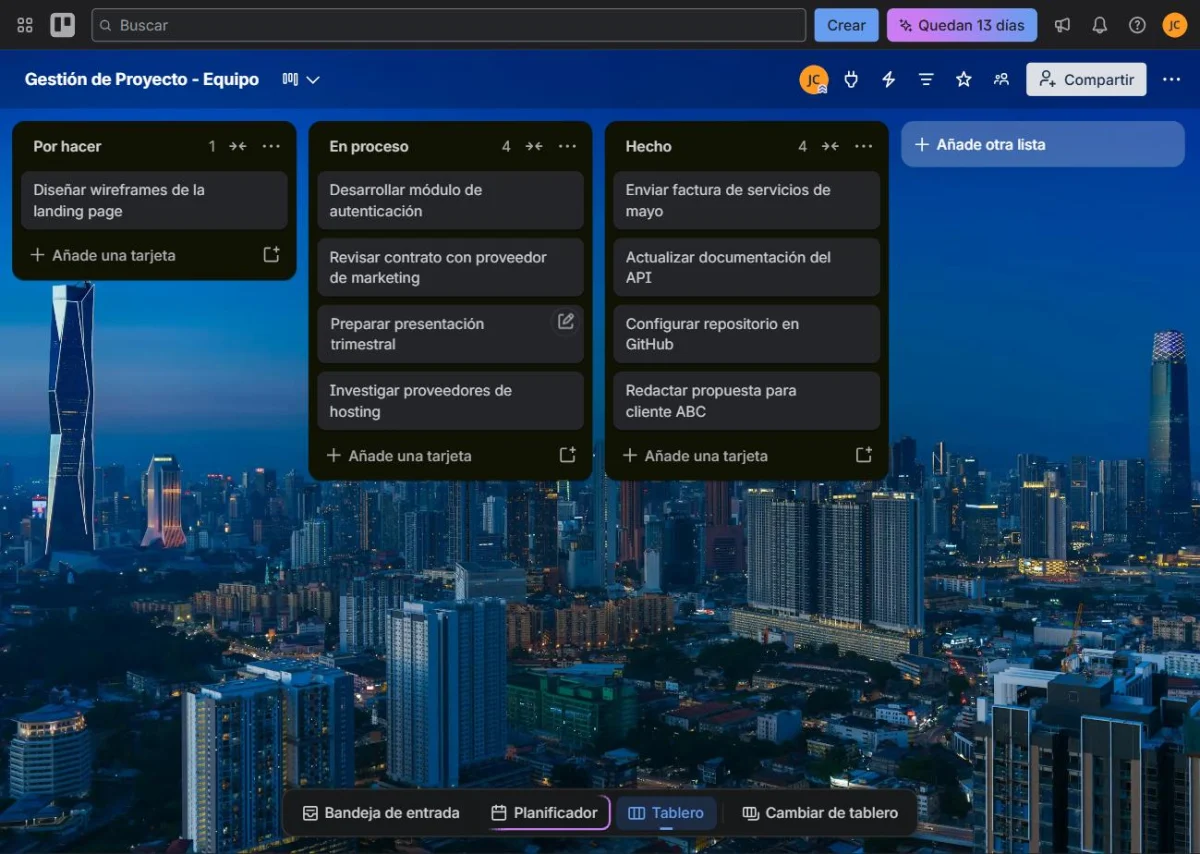
Trello is one of the best-known free alternatives to Asana. It is also the easiest to adopt when the team has never used a task manager. Its board format with cards is understood in minutes. The free plan allows up to 10 collaborators per workspace and 10 boards per space. Plus, it includes unlimited storage, with files up to 10MB each.
It also adds 250 automation runs per month. So, that's usually enough for a small startup just organizing its first sprint. If the team grows beyond that, the Standard plan costs $5 per user per month billed annually. Even so, it is still the cheapest option on this list to make the jump to a paid plan.
ClickUp: the free alternative with more functions
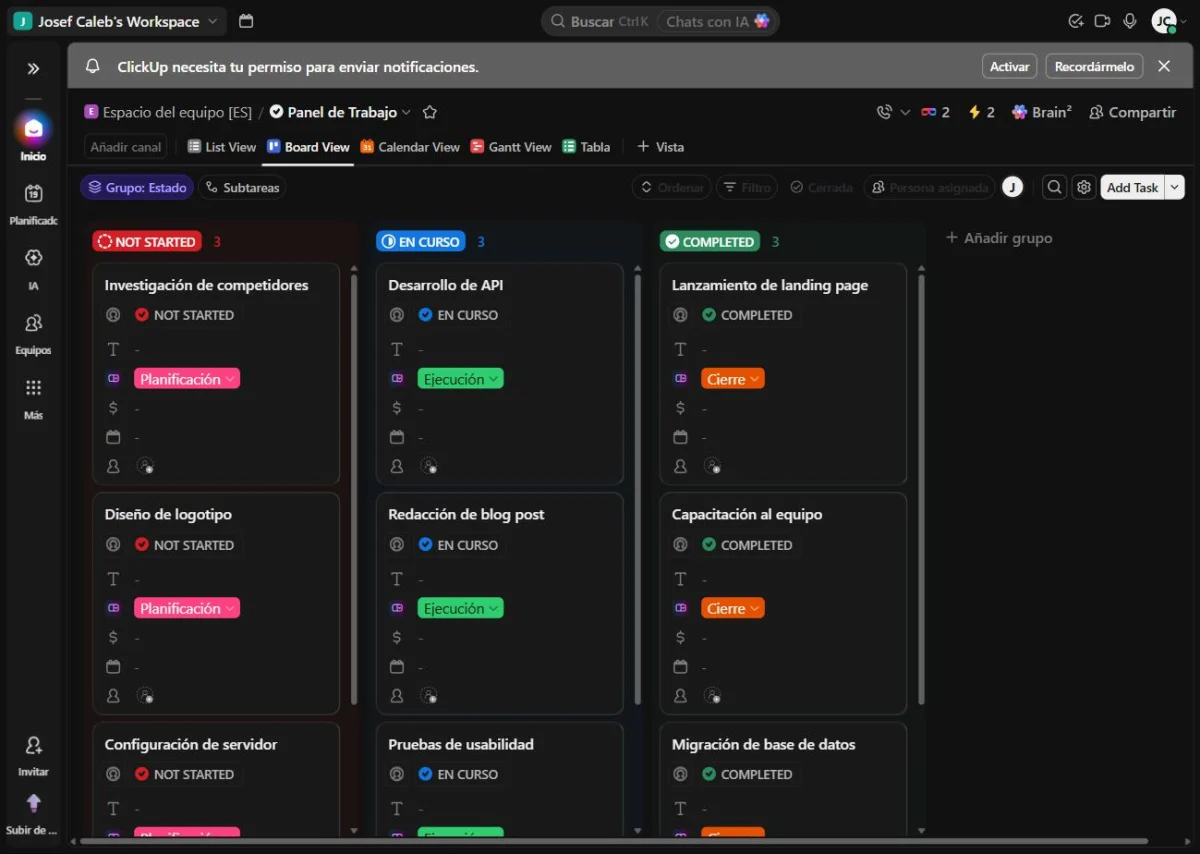
ClickUp is another free alternative to Asana worth considering. In fact, it opts to include almost everything in its free plan. The Free Forever plan offers 60MB of storage and unlimited tasks. In addition, it adds collaborative documents, kanban boards, sprint management and calendar view. That's quite a bit more than Asana's free plan.
Of course, the number of options can feel overwhelming at first. Therefore, it is a good idea to set up only two or three views before inviting the entire team. When you need unlimited spaces or native time tracking, upgrade to the Unlimited plan. It costs $7 per user per month billed annually, still below what Asana charges on its Starter plan.
Notion: when you need to document as well as organize tasks
Notion is the third of the free alternatives to Asana that many startups end up trying. However, he was not born as a task manager. Combine documentation, internal wiki, and project boards in one place. That's useful when the team is still defining processes. Of course, the free plan allows unlimited pages and blocks, but limits uploaded files to 5MB each.
Plus, it saves only 7 days of page history and supports up to 10 external guests. If your startup already works with extensive documentation and automations, the Plus plan costs $10 per user per month. Therefore, to better understand if it is suitable compared to a more traditional task manager, check out our comparison between Notion and ClickUp.
Comparison table: free alternatives to Asana in 2026
| Tool | Free plan | Plan paid from | Ideal for |
|---|---|---|---|
| Asana | Up to 2 users, unlimited tasks and projects | 10.99 USD/user/month (annual) | Teams that already know Asana and just need to grow |
| Trello | Up to 10 collaborators per space, 10 boards | 5 USD/user/month (annual) | Small teams that prioritize visual simplicity |
| ClickUp | Unlimited tasks, 60MB storage | 7 USD/user/month (annual) | Teams that want a lot of features without paying |
| Notion | Unlimited pages, files up to 5MB | 10 USD/user/month | Teams that document and manage tasks in one place |
Therefore, before deciding, it is a good idea to try each free plan for one or two weeks. For example, use actual team tasks, not example data. This way you can quickly tell if any limit on users, storage or guests is really going to hold you back.
Wrike Free and MeisterTask Basic: two additional options
| Tool | What does your official documentation confirm? | When can it fit | Limit you should check |
|---|---|---|---|
| Wrike Free | Includes folders, projects, tasks, subtasks, comments, files, and Table, Board, and Chart views. | Small teams that need more structure than a simple list. | A single shared space and a maximum of 200 active tasks/subtasks. |
| MeisterTask Basic | Free plan with up to 3 projects and unlimited tasks. | Startups that want a simple Kanban and few active projects. | The limit of three projects may be insufficient if the portfolio grows. |
Official sources: Wrike Free and MeisterTask plans. Limits and conditions may change.
What to look at besides the price before deciding
Price is not the only thing that matters. For example, before migrating your entire workflow, review how easy it is to invite external clients or vendors. Also, check to see if the tool integrates with what you already use, like Gmail, Slack, or Google Drive. And it confirms how quickly support responds when something breaks mid-sprint.
Trello and ClickUp offer chat support even on the free plan. Notion, on the other hand, only provides email support on free accounts. That's something to consider if your team depends on resolving questions quickly. In short, none of these alternatives bind you with long contracts. So changing tools later shouldn't be a big problem.
How to choose between these alternatives depending on the stage of your startup
When choosing between these free alternatives to Asana, it all depends on two things. How many people need access today, and how soon you will need reports or automations. If your startup is just starting out and the team is 3 to 5 people, Trello is usually enough. It's simple, quick to set up, and the free plan doesn't immediately fall short. If, on the other hand, you already manage several projects in parallel, ClickUp gives more margin before paying.
When the priority is to centralize documentation as well as tasks, Notion makes sense. Of course, it requires more discipline to avoid getting messy. On the other hand, if your team is already willing to pay for something more visual and with dedicated support, there is another option. Since we've reviewed it in depth, it's worth reading our analysis of whether Monday.com justifies its price for an SME.
Free Asana Alternatives FAQ
Yes. The official Wrike documentation describes a Free plan with tasks, subtasks, comments, files, and Table, Board, and Chart views; It also indicates limits of a shared space and 200 active tasks.
The official MeisterTask documentation indicates that Basic allows you to create up to 3 projects and unlimited tasks.
Choose based on the main constraint: Wrike if you need multiple views and structure, MeisterTask if your flow fits on few boards, or a simpler alternative if you are still validating the process.
What is the closest free alternative to Asana? Trello is the closest in simplicity among the free alternatives to Asana. ClickUp, on the other hand, offers more features within its free plan.
Trello or ClickUp for a small startup? Choose Trello if the team is new to task management. Choose ClickUp if you already need reports or automations from the start.
Can I easily migrate my tasks from Asana to another tool? Yes. In fact, Trello, ClickUp and Notion allow you to import tasks from a CSV file exported from Asana in just a few minutes.
Is it worth paying before you need it? No. Start with the free plan of the tool that best suits you. Go up the plan only when the limit really stops you.
Compare the flow before changing platforms
Use our task and project tool for SMEs to define states, responsible parties and priorities before choosing an alternative.
Free alternatives to Asana: in summary
Choosing between these free alternatives to Asana depends less on which one is best in the abstract. It depends more on what your startup needs at this exact stage: simplicity, features, or documentation. Therefore, try two options in parallel for a week with real tasks. Do this before committing to a paid plan. In summary, in the next article we show you how to create a Kanban board from scratch. It doesn't matter which of these tools you end up choosing.