
Does your online store still live between spreadsheets, WhatsApp and order captures? Having good management for online stores makes a difference. On the one hand, avoid losing sales due to stock errors. On the other hand, it helps to grow in an orderly manner. In fact, many SMEs only look for this solution when they have already lost a sale due to lack of updated inventory.

Before choosing, organize your inventory so as not to lose sales
Before choosing any platform, it is a good idea to sort out your inventory. Furthermore, that is where most SMEs lose money without realizing it. If you're still counting products in Excel, check out our guide on alternatives to Excel for inventory control in SMEs. Since this previous step avoids errors when connecting your store to a management system for online stores. e-commerce, according to its most accepted definition, is the sale and purchase of products over the Internet. Therefore, that is precisely the terrain where your business competes.
Shopify: what it includes and how it works
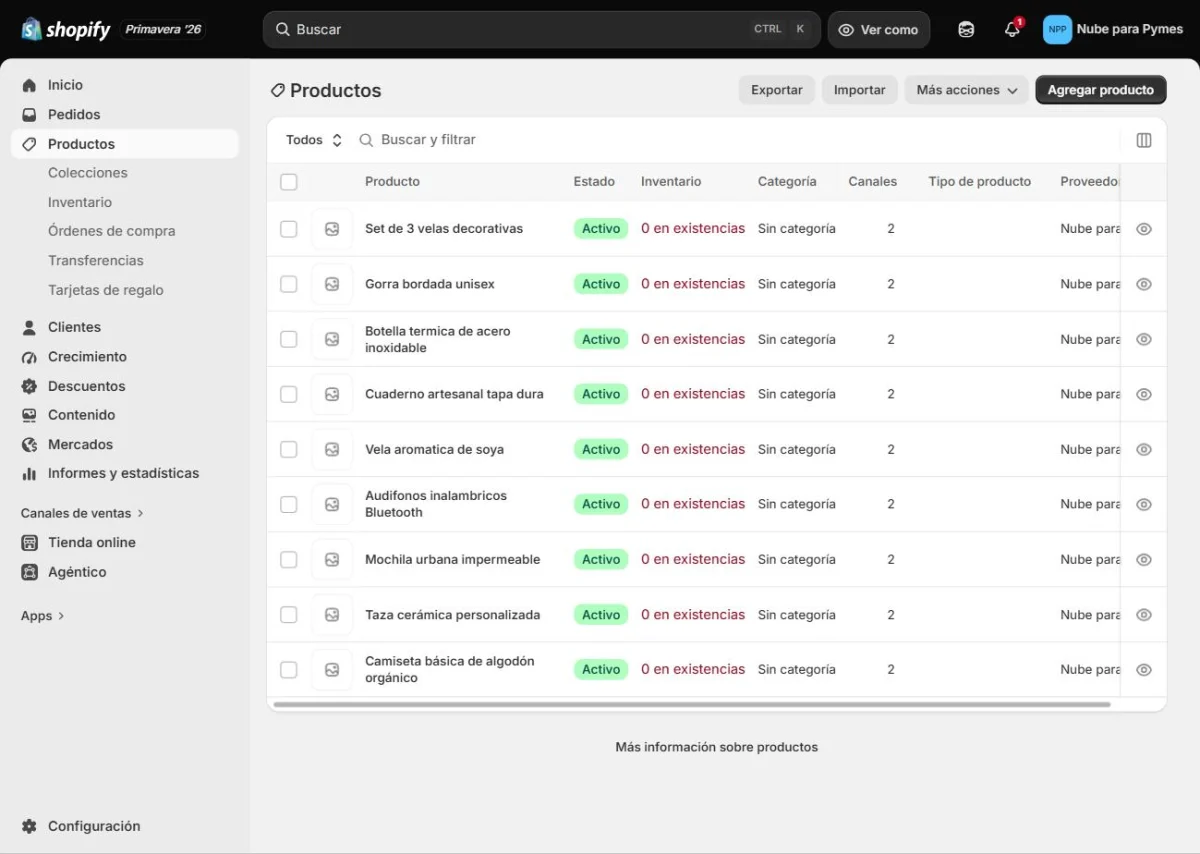
Shopify offers a centralized dashboard to manage products, orders, inventory, and customers. In addition, everything is managed from a single screen, just like the control panel of a real store with several active products. On the other hand, the platform integrates payment gateways and shipping calculations. It also adds sales reports without the need to install additional plugins. Thus, it has a wide application store to add specific functions for your field.
How much does Shopify cost
Shopify's Basic plan costs $29 per month with annual payment. With monthly payment, however, it rises to $39, according to the official site verified today. The Grow plan, for its part, costs $79 per month with annual payment, or $105 without annuity. In addition, this plan adds more advanced reports and better shipping rates. Therefore, a store that is just starting out can start with the Basic plan. You can then upgrade your plan when the volume of orders justifies it.
What to look at besides the price
What to look at besides the price matters as much as the final number on the invoice. Transaction fees, for example, can inflate actual spending. The same goes for the cost of additional applications. Likewise, it is a good idea to review how many products and variants each plan allows before migrating your catalog. If your store already does accounting in another system, this guide on accounting software for SMEs helps you decide whether to integrate it or change it.
What this looks like in practice
A small store with few active products gains order almost immediately with good management for online stores. That's why it's enough to centralize orders and inventory in a single panel. A store with a larger catalog, on the other hand, makes better use of sales reports. You also get more out of marketing integrations. However, no software replaces a good trading strategy. In fact, it only organizes the operational part of the business.
How to choose according to the size of your store
If you sell less than twenty products and are just starting out, Shopify's Basic plan is usually enough. Thus, it allows you to operate without complications from day one. If, on the other hand, you already manage several sales channels, the Grow plan is more suitable. That is why it offers better rates and more complete reports for a high volume of orders. Since each industry has different needs, it is a good idea to try the free trial period. This way you avoid committing to an annual plan before you are sure.
Frequently asked questions about management for online stores
Do I need to know how to program to set up my store? No, Shopify does not require programming knowledge for basic setup tasks.
Can I sell on social networks from the same platform? Yes, in fact the platform connects directly with Instagram, Facebook and other sales channels.
What happens if my store grows a lot? That's why there are higher plans with more features. They are designed precisely for stores with a higher volume of orders.
Can I migrate from another platform without losing my catalog? Yes, although migrating each product by hand takes time at first. Since there are import tools that help with this migration.
Management for Small Online Stores: in summary
Choosing the right management for online stores depends on two things. The size of your catalog and how many orders you handle each month. Shopify covers everything from a startup store to a business with larger sales. Their prices range from $29 to $399 per month depending on the plan. In the next article in the series we review the point of sale software for small restaurants. Another case where choosing the right system makes a difference.