

Customer search behavior is changing at the fastest rate in two decades. Today, thousands of business owners and decision makers no longer browse through ten blue Google links to compare services: they ask ChatGPT, Perplexity, or Google's AI Overviews directly.
This is where GEO (Generative Engine Optimization) comes in: the natural evolution of web positioning. If your website is only intended for old keywords, AI engines will simply ignore your brand. This technical guide summarizes the exact criteria and methodological framework for your SME to become a source referenced by language models in 2026.
1. From the 10 blue links to the synthesized answer
In traditional SEO, the main goal was to rank for a keyword to attract a click. In the artificial intelligence ecosystem, the generative model reads dozens of sources, extracts the most precise data and writes a personalized response to the user citing only 2 or 3 reference sources.
For your website to be one of those chosen sources, the content must respond to three non-negotiable principles:
- Density of verifiable facts: Avoid empty introductions or editorial filler. AIs reward direct data.
- Citation format: Write concise definitions that can be extracted directly in a single sentence.
- Semantic structure: Strict hierarchy of H2 and H3 headings that clearly divide subtopics.
2. The 4-Phase Framework for Implementing GEO
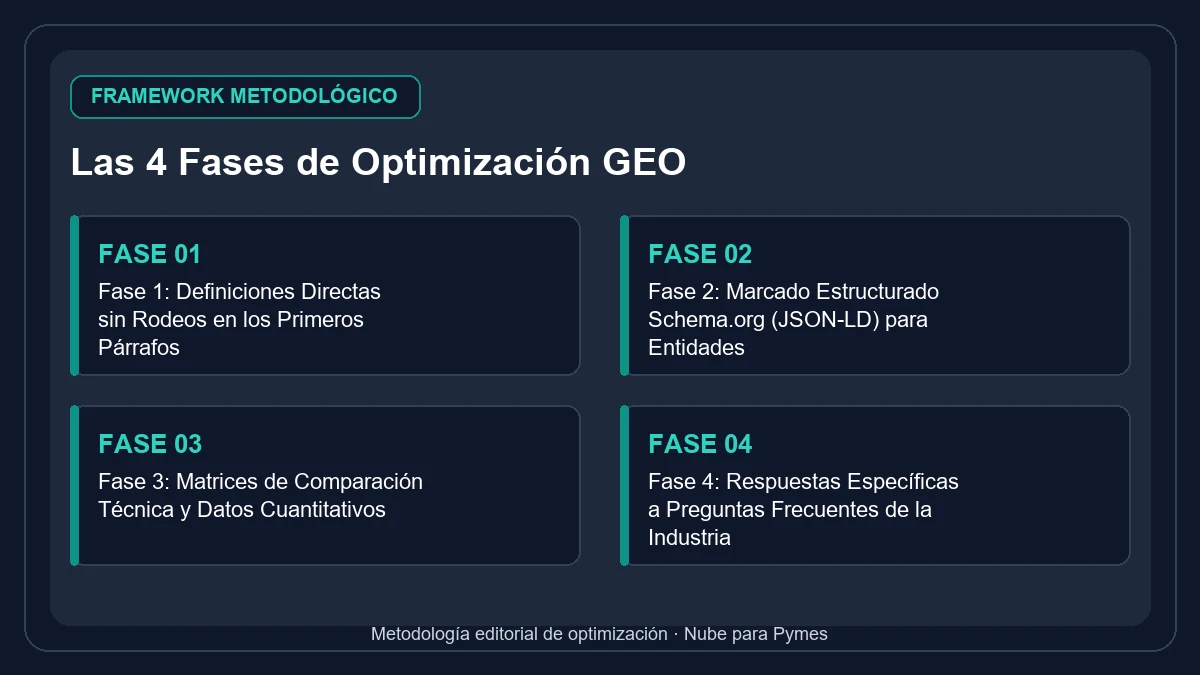
Implementing GEO does not require redoing your website from scratch or hiring million-dollar consultancies. It requires organizing the information architecture under a structured method:
- Direct definitions: Each main section should begin with a direct answer of less than 50 words that defines the concept before developing it.
- JSON-LD Schemas: Implement Schema.org structured markup to identify real authors, organizations, and FAQ modules.
- Decision matrices: Organize pros, cons, requirements, and limits of each tool or service in machine-readable table format.
- Authorship support: Clearly indicate who writes, their verifiable experience and links to verified professional profiles.
3. Comparison Matrix: Traditional SEO vs. GEO
Understanding the practical difference between both strategies allows you to allocate time and resources to actions that generate real impact:
| Criterion | Traditional SEO (Google Classic) | GEO (Generative Engines / AI) |
|---|---|---|
| Final goal | Get the click on the results page | Be cited and recommended as an expert answer |
| Key metrics | Ranking position (Top 3) | Frequency of mention and sentiment in AI responses |
| Content type | Long texts with repetition of keywords | Accurate synthesis, numerical data and comparative tables |
| Preferred format | Long articles with H2/H3 headings | Structured schemes, FAQs and decision matrices |
| Impact for SMEs | Difficult to compete with giants with thousands of backlinks | Very accessible for SMEs that dominate specialized niches |
4. How to optimize your content architecture today
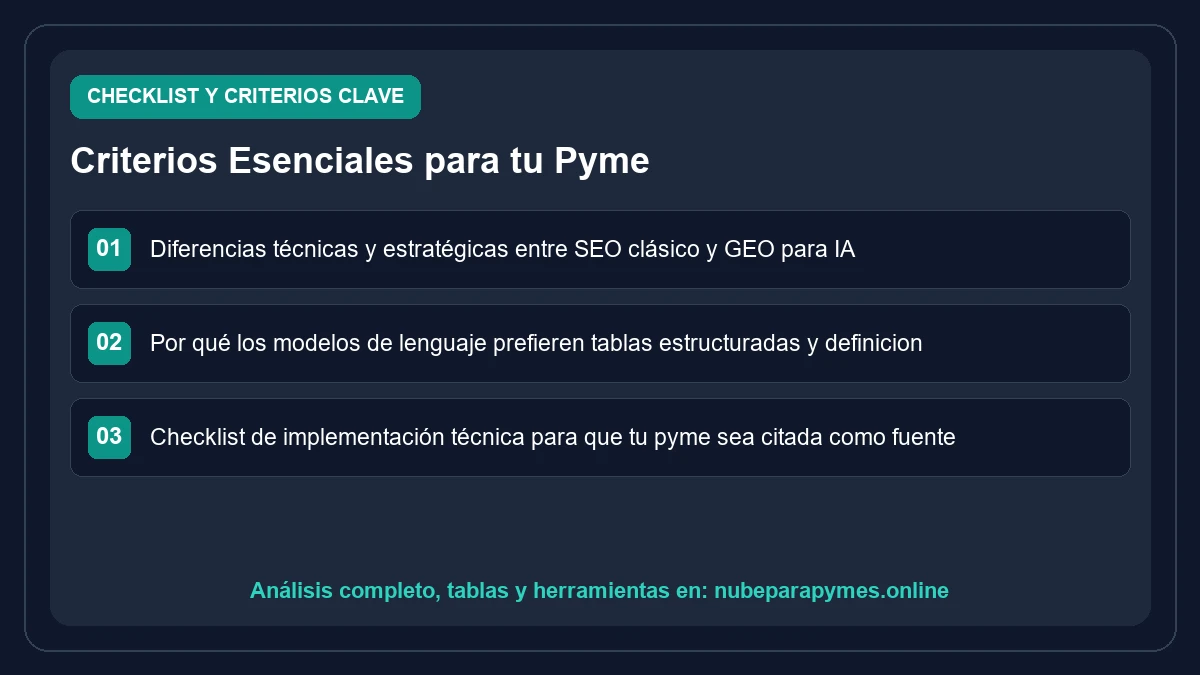
To audit your website for generative engines, apply this technical checklist:
- Incorporates comparative tables: LLMs have an algorithmic preference for extracting tabulated content because it reduces semantic ambiguity.
- Add frequently asked questions (FAQ) sections: Ask questions exactly as a user would dictate or write them to an AI assistant.
- Includes numerical data and ranges: Instead of saying "It is an economical solution", write "Their basic plan starts at $15 USD per month and covers up to 3 users".
- Maintain a quick and accessible index: A file like `llms.txt` in the root of your domain allows AI crawlers to map your entire catalog in seconds.
Frequently Asked Questions (FAQ)
What is GEO and how is it different from traditional SEO?
GEO (Generative Engine Optimization) is the technical discipline aimed at structuring information so that language models (LLMs) such as ChatGPT, Perplexity or Gemini cite and recommend your business as a reliable source. While traditional SEO looks for clicks on a list of blue links, GEO looks for AI to synthesize your content and mention your brand in its direct response.
Why do AIs prefer comparison tables and structured data?
Generative engines analyze millions of tokens to reduce hallucinations. Tables with clear data, pros, cons and prices are ideal for model processing because they offer immediate and verifiable logical relationships.
Can a small company compete in GEO against big brands?
Yes. Generative engines value technical specificity, niche topic authority, and direct data over advertising budget or domain age.